

The Global Race in Hearing Aid Technology: How Innovation Is Reshaping the World
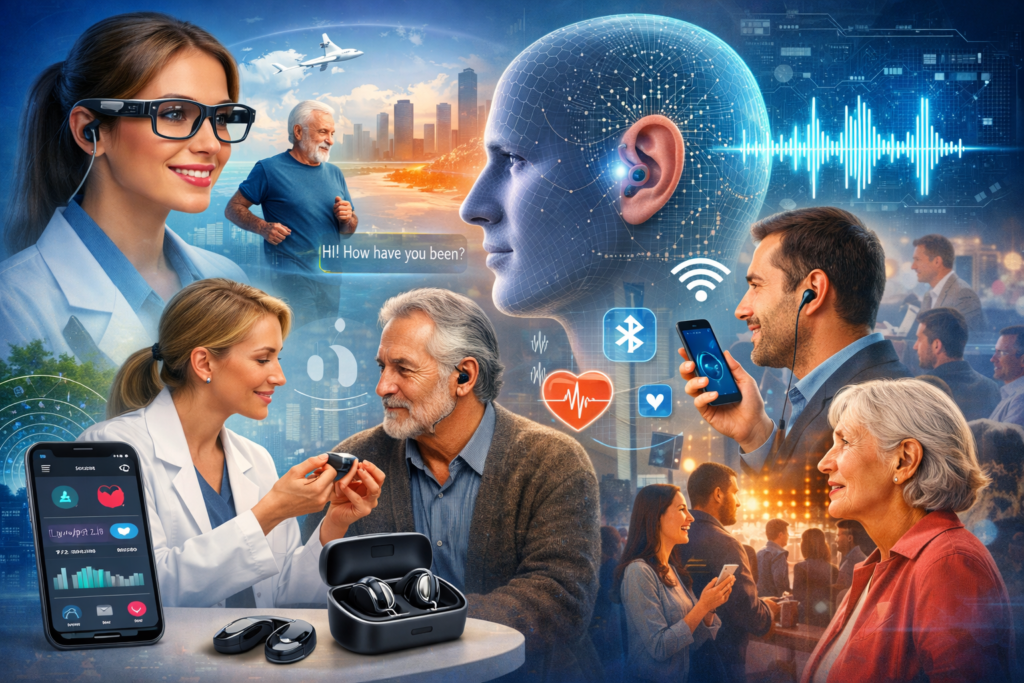
Introduction
The world is undergoing a quiet but profound transformation in hearing healthcare. What was once a niche medical device industry focused on simple sound amplification has evolved into a high-tech battleground where manufacturers are racing to integrate artificial intelligence (AI), health monitoring, and consumer electronics into hearing aids.
This shift is not just technological—it reflects broader global trends: aging populations, rising hearing loss, and the merging of healthcare with everyday consumer technology.
1. A Rapidly Expanding Global Market
The hearing aid industry is experiencing strong global growth, driven by both demographic and technological factors. The AI-powered hearing aid market alone was valued at nearly $3 billion in 2025 and is projected to grow steadily in the coming years. ([Research and Markets][1])
Several forces are fueling this expansion:
- Aging populations worldwide
- Increased awareness of hearing health
- Rising demand for discreet, multifunctional devices
- Expansion into emerging markets, including parts of Africa and Asia
At the same time, the industry is becoming more competitive, with traditional manufacturers, tech giants, and startups all entering the space.
2. Artificial Intelligence: The New Battlefield
The biggest transformation in hearing aid technology today is the integration of artificial intelligence (AI).
Modern devices no longer simply amplify sound—they understand it.
Key AI capabilities:
- Real-time classification of sound environments (speech, noise, music)
- Automatic adjustment to surroundings
- Personalized learning based on user preferences
- Enhanced speech clarity in noisy environments
For example, leading devices now use deep neural networks to separate speech from background noise and adapt instantly to changing environments.
This marks a shift from passive hearing devices to active, intelligent assistants.
3. Personalization and Learning Devices
Manufacturers are competing heavily on personalization.
Today’s hearing aids:
- Learn user preferences over time.
- Offer app-based customization.
- Use machine learning to fine-tune sound.
Some systems even allow users to compare sound profiles (“A vs B”) and gradually build a personalized hearing model.
This reflects a broader global trend: healthcare becoming individualized and data-driven.
4. The Rise of Health-Tracking Hearing Aids
Hearing aids are no longer just about hearing—they are becoming health monitoring devices.
Emerging features include:
- Heart rate monitoring.
- Fall detection.
- Activity tracking.
- Cognitive health insights.
By 2026, hearing aids are expected to integrate biometric sensors that track overall health metrics in real time.
This positions hearing aids alongside smartwatches and fitness trackers in the growing wearable health ecosystem.
5. Convergence with Consumer Technology
One of the most disruptive trends is the merging of hearing aids with mainstream consumer electronics.
Examples of convergence:
- Smartphones connecting seamlessly via Bluetooth.
- Audio streaming directly to hearing aids.
- Wireless standards like Auracast enabling public audio access.
- Earbuds doubling as hearing devices.
A major milestone came when consumer earbuds were upgraded to function as clinical-grade hearing aids, signaling that the line between medical and consumer devices is disappearing.
This shift is increasing accessibility and reducing stigma—two major barriers in hearing healthcare.
6. New Form Factors: Beyond Traditional Hearing Aids
Manufacturers are experimenting with entirely new designs to gain an edge.
Innovations include:
- Smart glasses with built-in hearing support.
- AI-powered lip-reading glasses.
- Charging cases that act as remote microphones.
- Nearly invisible in-ear devices.
At global tech events like CES 2026, companies showcased devices that combine hearing enhancement, translation, and augmented reality features.
The result: hearing technology is becoming more integrated into everyday life—and less noticeable.
7. Industry Competition and Strategic Moves
The competitive landscape is intensifying rapidly.
- Traditional manufacturers are investing heavily in AI.
- Tech companies are entering the market.
- Retailers are moving into manufacturing.
A recent example is a major acquisition deal where a global hearing retailer moved upstream into production, aiming to control the entire value chain from R&D to sales.
This reflects a broader strategy: companies want end-to-end control to stay competitive.
8. The Shift from Medical Device to Lifestyle Product
Historically, hearing aids were:
- Bulky.
- Expensive.
- Stigmatized.
Today, they are becoming:
- Sleek and discreet.
- Connected and multifunctional.
- Stylish and lifestyle-oriented.
This transformation is crucial because many people delay treatment for years due to stigma. Modern designs aim to normalize hearing aids in the same way glasses or earbuds are accepted.
9. Challenges in the Innovation Race
Despite rapid progress, several challenges remain:
- Battery life vs processing power (AI requires energy).
- Affordability, especially in developing regions.
- Regulation and medical standards.
- Data privacy concerns with AI-driven devices.
- Bridging the gap between lab innovations and real-world use.
Researchers note that while AI models perform well in controlled environments, real-world deployment still requires optimization and standardization.
10. Global Impact: Why This Matters
The stakes are high.
- Over 1.5 billion people globally are affected by hearing loss (and rising).
- Untreated hearing loss is linked to:
- Social isolation.
- Cognitive decline.
- Reduced economic productivity.
The current wave of innovation is not just about competition—it is about transforming quality of life on a global scale.
Conclusion
The hearing aid industry is undergoing one of the most significant transformations in modern healthcare. Driven by AI, connectivity, and fierce competition among manufacturers, hearing devices are evolving into intelligent, personalized, and multifunctional systems.
This global race is reshaping not just an industry—but how humans interact with sound, technology, and each other.
In the coming decade, hearing aids may no longer be seen as medical devices at all, but as essential, everyday smart companions—blurring the line between healthcare and human enhancement.